A Celebration of Collaborative Research Down Under
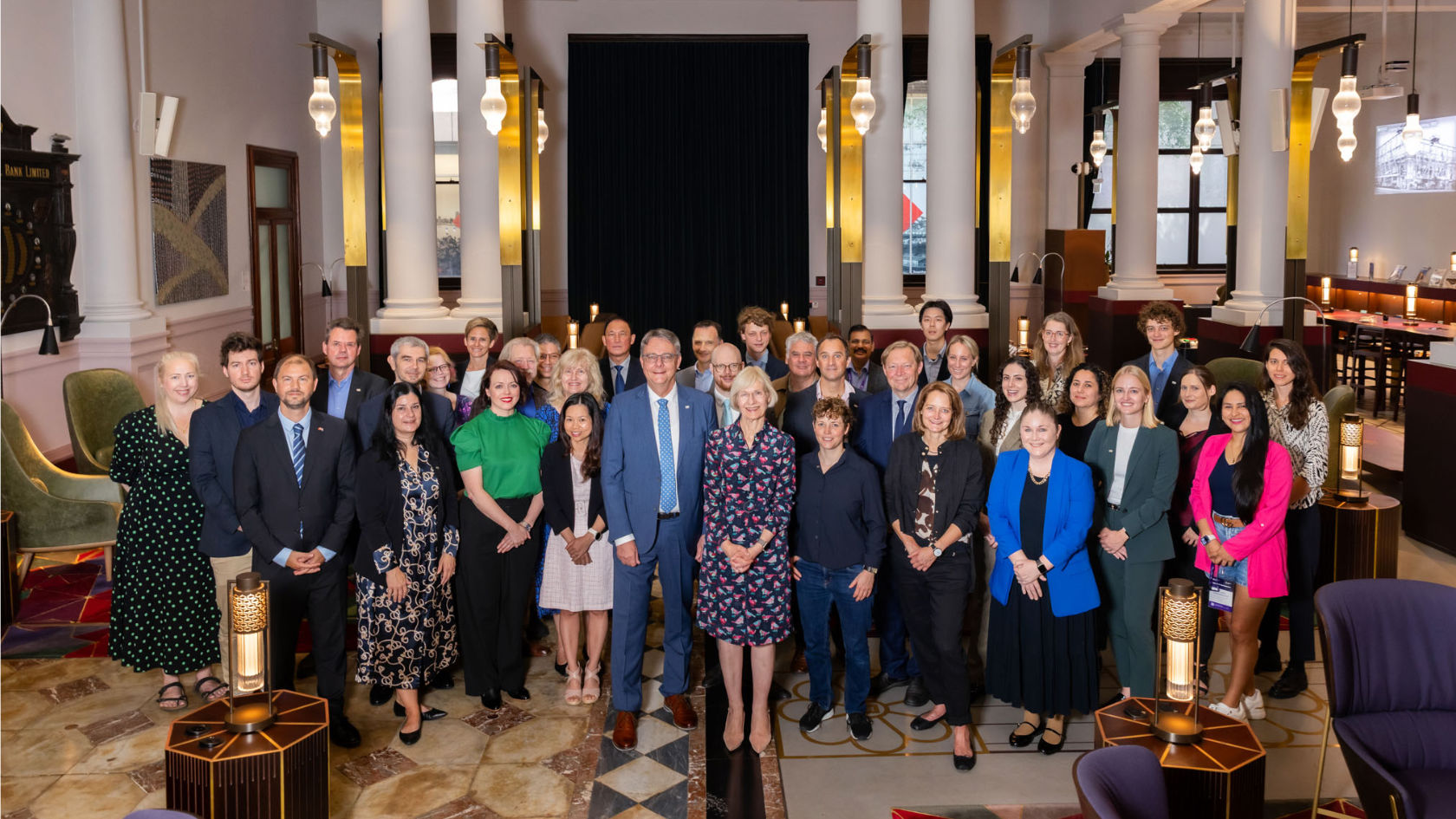
Last week saw a packed program of inspiring collaboration showcases on the topic of “Challenges and Opportunities for Social and System Change” in Brisbane, jointly delivered by researchers from the host institution, the University of Queensland, and visiting scholars from the University of Zurich (UZH). The event also served as an opportunity for scientists to exchange knowledge and expand on existing alliances and friendships as well as forge new ones.
The two universities indeed share a close bond. The University of Queensland is one of UZH’s six strategic partners, with active collaboration in the area of student mobility and summer schools, joint research and teaching projects and mutual support at governance level. Both are members of Universitas21, the global network of research-intensive universities.
This strong connection has resulted in successful research collaborations that have attracted substantial third-party funding. Examples of successful joint research include studies on long-term outcomes of pediatric critical care, rewiring plant reproduction for higher seed yields, and technology and democracy.
UQ-UZH research collaboration highlights
- UZH’s Luregn Schlapbach, Head of Pediatric Intensive Care and Neonatology, who also holds a PhD from the University of Queensland, and UQ’s epidemiologist Kristen Gibbons partnered on the project “Machine learning for precision medicine in pediatric critical care” that was funded by the Ramaciotti Foundation.
- Ueli Grossniklaus, Director of the Department of Plant and Microbial Biology at UZH, is part of the “Hy-Gain for smallholders” project, a UQ-led multinational collaboration funded by the Gates Foundation. The project aims to increase the yield of smallholder farm crops in sub-Saharan Africa by switching from the sexual to an asexual mode of seed formation.
- UZH’s professors Abraham Bernstein, Marco Steenbergen and Felix Uhlmann attracted an SNSF Sinergia Grant for their collaborative project with UQ researcher Gianluca Demartini on “Large-scale political participation: Issue identification, deliberation and co-creation”.
- UZH Professor of Criminal Law Gian Ege, together with his counterpart at the University of Queensland, Andreas Schloenhardt and colleagues from the Universities of Vienna, Ferrara and Cologne, has been organizing a joint module on transnational organized crime for undergraduate and postgraduate students for several years. The module’s success has sparked interest from other disciplines, which are considering using it as a blueprint for their own joint teaching initiatives.
Academic exchange is about people
“Our special bond began in 2004 with a Memorandum of Understanding (MoU), which led to the formal signing of a strategic partnership in 2021,” said Michael Schaepman, president of UZH in his welcoming address to the first UQ-UZH Symposium. Since then, it has blossomed into numerous scientific collaborations and the exchange of students and early career researchers.
As UQ Vice Chancellor Deborah Terry pointed out, academic exchange is about people, not just structures or financial schemes. Schaepman agreed, saying, “What unites the University of Zurich and the University of Queensland is a common commitment to excellent research, based on curiosity and collaboration driven by our researchers and students.”
-
 Early career researchers from the Unversity of Queensland and UZH with their supervisors. (Image: provided)
 -
 UQ professor Gianluca Demartini (left) and Fann Bachmann, PhD candidate from UZH, talk about the role of AI in democracy.
 -
 Presented innovations for healthy ageing: UQ professors Tim Kastelle and Nancy Pachana, UZH professor Mike Martin and PhD candidate Gabriela Morgensthern (from left to right).
 -
 UZH at the University of Queensland: productive collaboration in teaching and research.
 -
 The visit also provided an opportunity to initiate new projects: Dean Andrew Griffiths, Vice Chancellor Deborah Terry and Michael Schaepman (from left to right) signed the agreement for the Double Degree in Law between the UZH Faculty of Law and the UQ Faculty of Business, Economics, and Law. (Image: UQ)
 -
 Academic collaboration that integrates all viewpoints: The Australian Aboriginal Flag, the National Flag of Australia, the Torres Strait Islander Flag and the Swiss Flag. (Image: UQ)
Current and emerging research
At the symposium on 7 and 8 October 2025, participants discussed the challenges and opportunities of social change. Current research themes included pediatrics, agriculture, criminal law and healthy aging. Scholars from both institutions also presented their research on emerging themes concerning provenance histories, health and well-being in LGBTIQ+ communities, and the role of AI in democracy. The symposium also included a section where students and early-career researchers shared their work and findings.
Provenance histories

Curator Mandana Maper and director Michael Aird from UQ's Anthropology Museum, and UZH professor Martin Dusinberre (from left to right). (Image: provided)
Martin Dusinberre, professor of global history at UZH, highlighted the research on objects from First Nations Aboriginal and Torres Strait Islander communities that are present in museums around the world, including UZH’s own collections. Provenance research attempts to establish an object’s biography – from the moment the object was produced up until now. “How exactly did these objects get here?” he asked. “While some clues may be found in archives and museum paperwork, close collaboration with source communities is essential for a complete picture.”
Together with colleagues from the University of Queensland Anthropology Museum, Dusinberre discussed the considerable challenges of working with poorly documented ethnographic collections. “This symposium offered the invaluable opportunity both to meet our UQ collaborators in person and reiterate to colleagues from other disciplines why studying the historical legacies of institutional knowledge production and collection acquisition should be central to a university’s civic mission in the 21st century,” Dusinberre said.
Health and wellbeing in LGBTIQ+

UQ professor of psychology Fiona Barlow, UZH researchers Léïla Eisner and Tabea Hässler, and UQ professor of psychology Winnifred Louis (from left to right). (Image: provided)
As UZH social psychology researchers Tabea Hässler and Léïla Eisner noted, the experiences of LGBTIQ+ people around the globe are remarkably diverse. While some countries criminalize LGBTIQ+ people, others have enacted marriage equality and anti-discrimination legislation. These legal frameworks and the level of social acceptance significantly influence the lives of LGBTIQ+ people. “The current heavy focus on Western countries, therefore, limits our scientific understanding,” said Hässler. Global teams and data, as well as collaborations with key institutions and stakeholders, are crucial to better understanding how to promote belonging, health and well-being for LGBTIQ+ people worldwide.
“Together with our Australian colleagues, we analyzed Swiss and Australian data,” Hässler said. “We are now extending this Australian–Swiss collaboration to make it a truly global project uniting 110 scholars and practitioners from over 70 countries.” Hässler’s work builds on previous research conducted at the University of Queensland. There, Hässler established close collaborations with psychology scholars resulting in co-authored scientific papers, science communication projects and shared mentoring schemes. The global LGBTIQ+ survey is also supported by the UZH Population Research Center, of which Hässler is a member.
Switzerland and Australia: Better together
“Australia and Switzerland share a joint commitment to universal human rights,” Schaepman affirmed. “We share the vision of an open, inclusive and resilient society, and we both strongly support a rules-based international order.” Though they are geographical opposites, both countries are global innovation leaders.
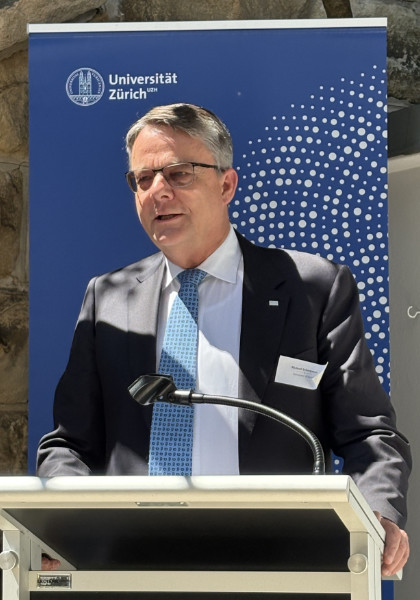
We share the vision of an open, inclusive and resilient society, and we both strongly support a rules-based international order.
Schaepman reiterated this sentiment at the event “Building Innovation Bridges between Switzerland & Asia-Pacific” in Sydney, organized by the Consulate General and the Swiss Embassy in Australia on 10 October to conclude the UZH delegation’s visit down under. The event also marked the launch of the Leading House Asia-Pacific’s presence in Australia – an important step toward deepening academic and scientific collaboration between Switzerland and the region. The strong collaborative ties are also reflected in the close partnership between UZH and the University of Queensland.
In his address, Schaepman highlighted the inspiring exchanges and new connections sparked during the visit, noting that research collaborations between Switzerland and Australia achieve more than twice the impact of publications from either country alone. This underscores the outsized impact of the almost 500 co-authored scientific publications between the two institutions in the past five years. Building on the success of last week’s symposium, many more are surely to come.