Einstein’s Dissertation: Groundbreaking Work in Physics

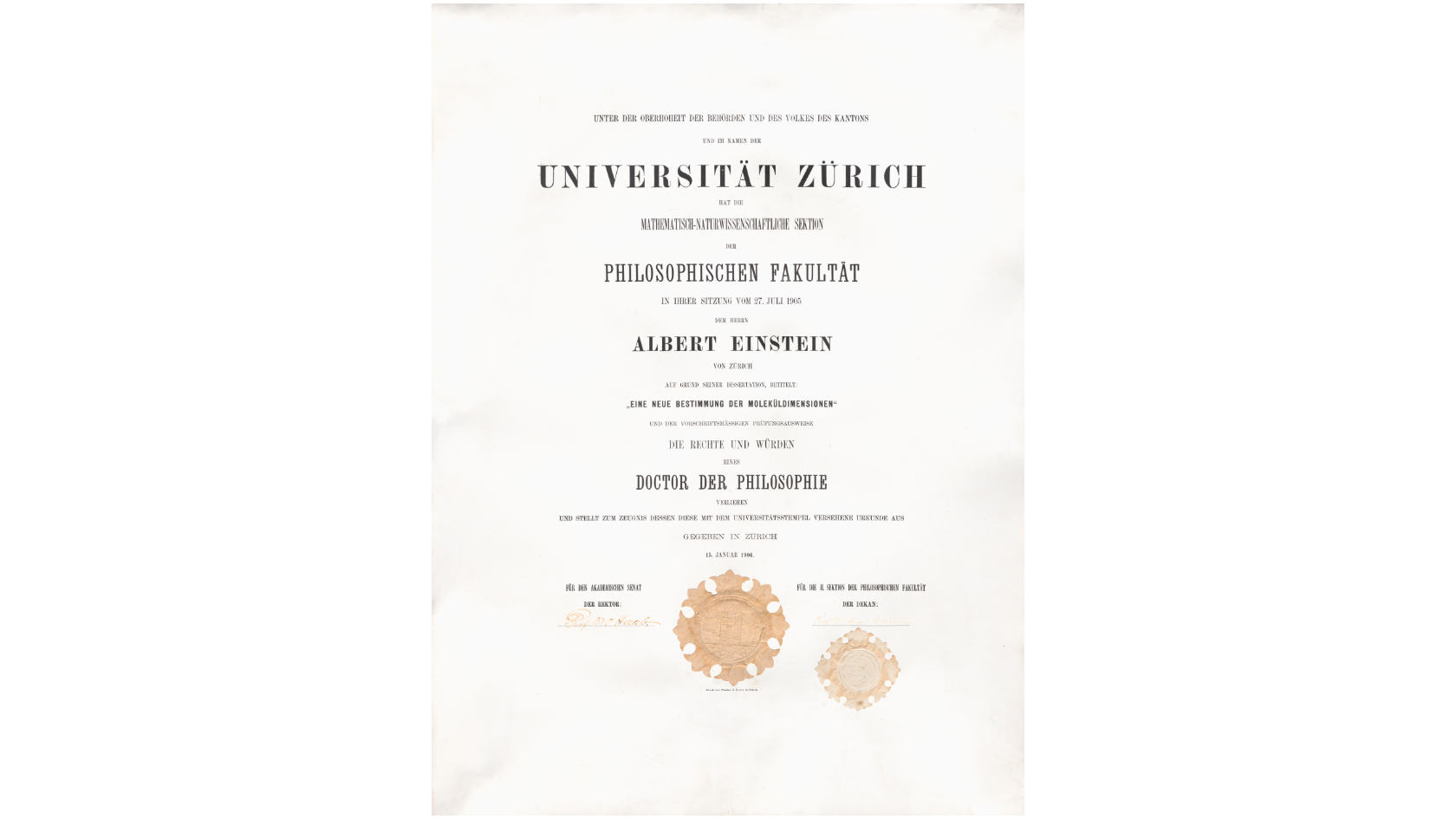
Albert Einstein’s career is closely linked to Zurich. From 1896 to 1900, the famous physicist studied at Eidgenössisches Polytechnikum (now ETH Zurich) and submitted his doctoral thesis A New Determination of Molecular Dimensions to the University of Zurich in 1905. On 15 January 1906, he received his doctorate as well as the corresponding certificate.
He subsequently served as professor of theoretical physics at UZH from 1909 to 1911. Einstein’s dissertation was frequently cited. Using data from sugar solutions of known concentration and a new diffusion formula, the physicist demonstrated how the viscosity of a liquid can be used to calculate molecular size and the number of molecules in one mole (Avogadro’s number). With this work, Einstein also supported the then-controversial hypothesis that postulated the existence of atoms.
The findings of this study have found broad application – including in the construction industry and in petrochemistry. It is also cited in ecological studies addressing the dispersion of tiny liquid droplets (aerosols) in the atmosphere.
Sources
Albert Einstein: Revolutionizing Physics. Publication on the occasion of the 100th anniversary of Albert Einstein’s Nobel Prize.
Norbert Straumann: On Einstein’s Doctoral Thesis. Talk given at the joint colloquium of ETH and the University of Zürich on the occasion of the 100th anniversary of Albert Einstein’s doctoral thesis, 2005