“Seeing the world through different eyes”
Has an international experience had a particular impact on you during your academic career?
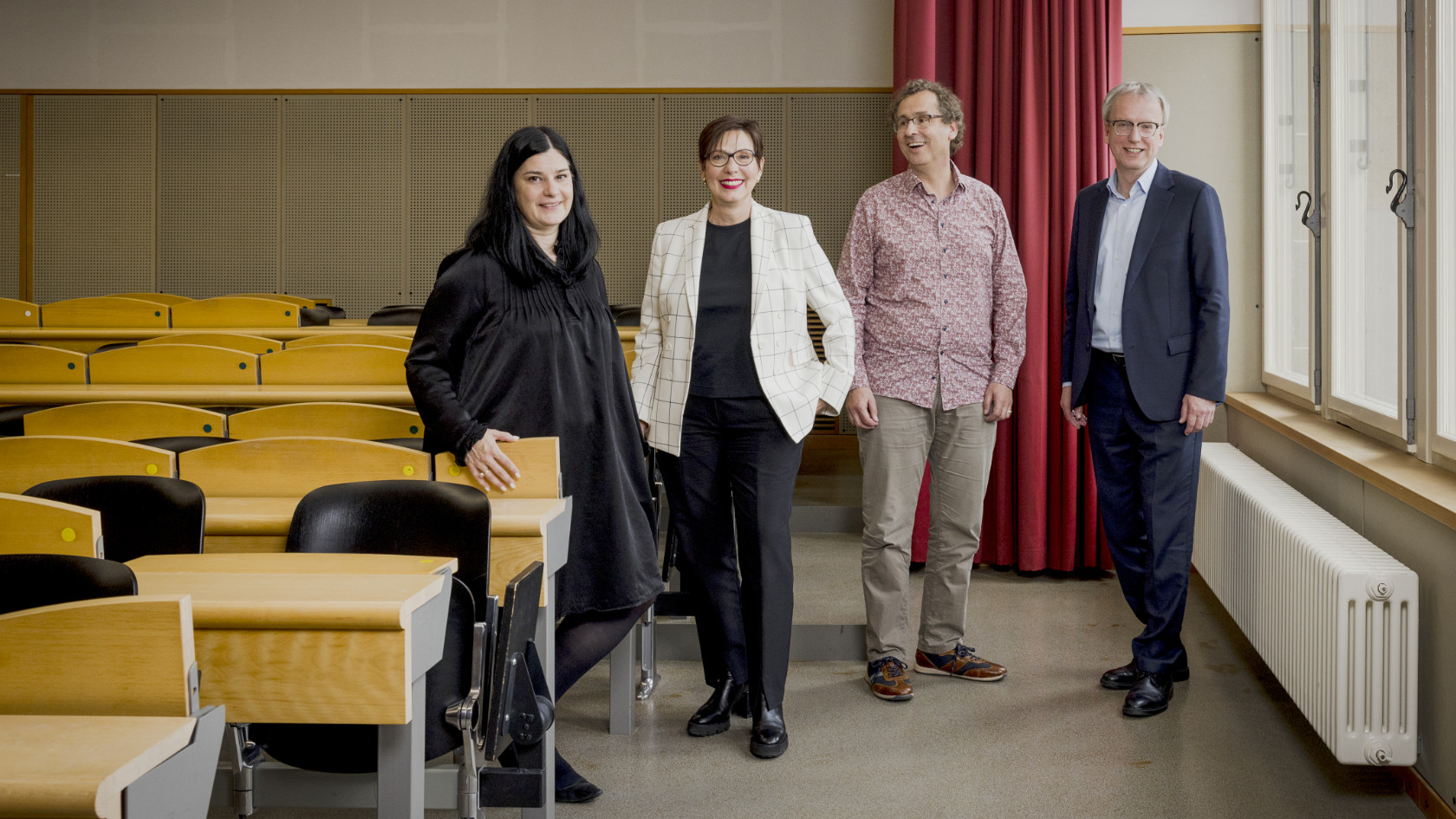
Stephan Neuhauss: I studied and did research in the United States for a long time. This period had a major impact on me – as a person, as a researcher and as an instructor. In the USA, I experienced a university culture that was markedly different from what I was familiar with: more informal, more direct, more open. I found that very liberating. This experience shaped how I teach and lead my research group today.
Andreas Heinemann: The two semesters I spent in Geneva as a student were particularly formative for me. I came from Germany, and being immersed in both the French language and the cosmopolitan atmosphere inspired me. Suddenly, I saw the world through different eyes, which allowed me to rediscover myself. I like to tell students about this to encourage them to have similar experiences.
Gabriele Siegert: Nobody ever talked about international mobility during my studies. I regret missing out on that opportunity very much because as a researcher, I have always greatly appreciated exchange with international colleagues. Even now as Deputy President and Vice President Education, this dialogue is incredibly beneficial. It is also interesting for the students to see the path their instructors have taken, and how they got to where they are today.
Katja Durkin-Sommerhalder: The 10 years I spent in the UK had a great impact on me. I spent a year in England during my studies, and later I lived and worked there in an international environment for another nine years. I got to know people from many countries, as well as seeing a results-oriented way of working firsthand. I still benefit from these experiences to this day – both professionally and personally.
Challenges do not stop at national borders
Why is internationality an essential part of studying and teaching today?
Gabriele Siegert: Firstly, international study contributes significantly to personal development and employability. It strengthens competencies such as analytical skills, adaptability, orientation and the ability to integrate different perspectives and bridge cultural differences. These so-called transversal skills are in demand in many professional fields today. Secondly, we are facing global challenges – for example, in the areas of climate, health, migration and digitalization – none of which can be solved within national borders. It’s therefore all the more important that students learn to understand and classify issues in a broader context – just as we do in research.

Stephan Neuhauss: The topics we tackle at the Faculty of Science – such as climate and biodiversity – affect the entire world. This is also reflected in our range of courses, which include, for example, field courses and research internships around the world. There is a good chance that our students will go on to work in an international environment, regardless of whether they stay in research or switch to another professional field. We prepare them well for this.
Andreas Heinemann: Intercultural skills are important for lawyers, even those who work exclusively in Switzerland. Switzerland is a multilingual country and has strong global connections. Accordingly, there is a demand for people with the skills to build bridges across cultures. In the bilingual joint Master’s degree program in law, offered by UZH in collaboration with the University of Lausanne, students get to know two linguistic and legal cultures simultaneously. What’s more, our faculty offers many opportunities to delve deeper into European and international law.
The possibilities are becoming increasingly diverse
Many people think studying abroad means doing an exchange semester. Is that the only way to make studies international?
Gabriele Siegert: UZH’s Global Strategy aims to offer all students the opportunity to have a formative international experience during the course of their studies and encourages them to make the most of this option. An exchange semester is a particularly established way to do this. With its tight network of partner universities across the globe, as well as organizational and financial support, UZH provides very good conditions for this.
However, an international exchange is not equally feasible for all students. Factors such as financial circumstances, personal obligations and the structure of individual degree programs can present obstacles. However, there are many different ways to study internationally – not just through an exchange semester.
What other opportunities does UZH offer?
Gabriele Siegert: The possibilities are becoming increasingly diverse. They range from international study programs such as the Una Europa Joint Bachelor of Arts in European Studies (BAES) to flexible, short and intensive formats such as summer and winter schools, research internships and micro-credentials that students can easily integrate into their degree programs.
Courses are also increasingly offered jointly by UZH and a partner university. Many of them are based on the concept of Cooperative Online International Learning, known as COIL for short. Some of these formats also include short periods of in-person attendance, such as excursions or workshops at a partner university.
However, internationality is not only reflected in teaching formats, but also in terms of the content and in collaborative learning – when global topics are addressed, international perspectives are embraced, guest lecturers from abroad are invited, or students from different countries are brought together.
Katja Durkin-Sommerhalder: The growing diversity of international courses at UZH is a great benefit for students because it caters to different individual needs. The greater the diversity, the better international experiences can be integrated into degree programs – either in person or virtually, on site or with longer or shorter trips abroad.
International courses are becoming more visible
How can students identify which courses have an international focus when planning their studies?
Gabriele Siegert: International teaching formats are now highlighted in the course catalogue. They can be easily found under the heading “Course features”. This makes it easier for both incoming students and UZH students to plan their studies in a way that includes suitable international teaching formats.
Which forms of international teaching have proven particularly successful at your faculties?
Andreas Heinemann: At the Faculty of Law, double degree programs at the Master’s level are the most popular form of mobility studies. Along with our partner universities, we offer 13 such programs on all inhabited continents. They are particularly valuable for deepening professional and intercultural skills.
However, we don't only encourage our students to go abroad – we also bring the world to Zurich. For example, we invite visiting professors to teach at our faculties for two or three weeks, during which time they contribute topics that specifically complement our expertise. In May, we also conducted a Blended Intensive Program (BIP) on the topic of climate law for the very first time. It consisted of a three-week online preparatory phase, followed by a week of in-person classes at the West University of Timișoara in Romania. This was an excellent opportunity to bring together students from very different countries in a low-stakes way.
Stephan Neuhauss: Studies at the Faculty of Science are very structured, which means it’s difficult to spend time abroad in the early and middle stages. The later phase, however, offers much better conditions. Many students travel to research stations to conduct experiments as part of their Master’s thesis, which gives them the chance to collaborate with researchers and students from all over the world.
One example is a project in Colombia in which geography students study glaciers in the Andes and then prepare a policy brief for the authorities alongside local partners. Many things come together here: internationality, research, transdisciplinary collaboration and social impact.
Many ideas arise from research contacts
Now let’s take a look at the teaching staff. How do international teaching formats actually come about?
Stephan Neuhauss: They often arise from research contacts. You work together on an international project and then consider how the topic can be used in teaching.
Andreas Heinemann: However, arranging cross-border teaching projects is much more complex than research projects. It’s important to observe basic regulatory principles such as the framework ordinance and program regulation, to integrate content and quality into the curriculum, and to clarify matters of transfer of credit and recognition. These are often lengthy processes.
How does UZH support its teaching staff and study program coordinators when it comes to developing international teaching formats?
Gabriele Siegert: UZH supports its teaching staff and study program coordinators in the development of international teaching formats with advice, community building and financial support. The global_innovation funding line of the UZH Teaching Fund plays a key role here. Our goal is not only to make one-off international courses possible, but also to permanently anchor them in the range of courses available if they prove to be successful. The focus is therefore on supporting formats that can be repeated and have the potential to become stable features.
Una Europa has triggered a surge in development
How important are international university networks when it comes to further developing teaching?
Katja Durkin-Sommerhalder: University networks allow us to build long-term international relationships that have a broad base in terms of subject matter and involve a diverse team of staff. UZH is involved in three networks whose different profiles complement each other well. The League of European Research Universities (LERU) is a strong European network of leading research universities that primarily serves the purpose of exchange at the governance and policy level. U21 has a global focus and allows UZH to work closely with leading universities around the world. Meanwhile, the Una Europa alliance concentrates on the joint further development of an international range of courses within the European context.

Gabriele Siegert: Una Europa doesn’t just promote student mobility, it’s also a platform on which new ideas can be jointly tested and further developed. Collaboration with the partner universities has been the trigger for a major surge in development at UZH. In addition to joint study programs at the Bachelor’s and Doctoral levels, smaller, more flexible formats have also emerged, such as a MOOC entitled AI in Society and the online format Una Europa Virtual Exchange for Sustainability (UNAVex). The concept of module exchange, which allows students to integrate teaching modules from other universities in the alliance into their studies, is also designed with the future in mind.
Katja Durkin-Sommerhalder: Compared to other world regions, Europe offers particularly good conditions for the further development of international teaching, thanks to comparable educational systems, coordinated funding instruments and a high level of academic freedom. Models can be developed and tested in the European Higher Education Area, and especially in the Una Europa network, then later can also be implemented at the global level.
Gabriele Siegert: And this is precisely our next goal. Much of what we have learned within the framework of Una Europa could also be of interest to the globally oriented U21 network, which has so far been less active in the field of teaching. In November 2026, the U21 Global Education and Senior Leaders’ Meeting will take place in Monterrey, Mexico. Alongside a colleague from Helsinki, I will go there to talk about how to specifically promote student engagement in teaching. This is a clear opportunity to transfer experiences from Una Europa to a global context.
Implementing international study programs not only requires creativity and relationship management, it is also organizationally complex. Do university networks and bilateral partnerships help in this regard?
Katja Durkin-Sommerhalder: Developing and implementing joint international courses is challenging. University networks make many things easier, and our six bilateral strategic partnerships are also very useful because we know each other well. Two of these are with universities outside Europe – Kyoto and Queensland, the latter being a U21 member. Initially, these partnerships primarily focused on joint research, but now they increasingly benefit teaching as well.
Andreas Heinemann: When there is an overarching will to cooperate at the university level, it facilitates the implementation of certain projects. A good example is the double degree in law, offered by UZH and the University of Queensland. This joint study program was an extraordinarily demanding project in administrative terms, because Australia’s university system is very different from Switzerland’s, but the strategic partnership between the two universities gave us the necessary impetus.
Gabriele Siegert: The effort is worthwhile because it creates blueprints for other similar projects. What we develop and learn can then be applied again later following a similar pattern. The fact that the University of Queensland and UZH are now both members of the U21 university network also provides a basis in which to structurally anchor such initiatives. Proven formats taken from university networks can be further developed and transferred to other contexts.
Internationality also takes place outside of courses
Can students at UZH also have international experiences outside of courses?
Katja Durkin-Sommerhalder: Yes, definitely. “Internationalization at Home” is a separate topic in UZH’s Global Strategy. It’s about how international we consider ourselves to be as a university. What information is available in which languages? How open are we to international students and staff? How well are we integrating them? Our goal is to make campus life and administration even more open and international, and to continue growing UZH as a place where global perspectives come together. From my point of view, there’s already been a lot going on in this regard in the past 10 years: the proportion of international teaching staff has increased, and you can hear many languages on campus.
Stephan Neuhauss: Incoming students contribute a lot to UZH’s international atmosphere and the attractiveness of the university in general. As the lingua franca of academia, English plays an important role: it facilitates exchange and integration in everyday student life, as well as in personal interactions. This means that internationality arises organically on campus, not just in students’ courses.
Gabriele Siegert: Meanwhile, German as a foreign language is particularly in demand at the Language Center. Many international students and lecturers want to learn German in order to be able to communicate better in their day-to-day lives, and to integrate more fully.
Where should internationality in teaching and study at UZH be in five to ten years?
Gabriele Siegert: I hope that internationality will be a given within this time frame – not an add-on, but an integral part of studying and teaching at UZH. If that succeeds, then perhaps there will be no need for an interview on internationalization.
International Teaching Formats
Specific opportunities for promoting international experience during studies include:
- Physical mobility programs such as exchange semesters and research stays within the framework of bilateral agreements, Erasmus+, the Swiss-European Mobility Program (SEMP) and Una Europa. They allow students to get to know international higher education and research cultures and to strengthen their intercultural skills.
- Virtual and hybrid exchange formats: Online formats such as Cooperative Online International Learning (COIL) provide students with intercultural experiences and insights into different perspectives via the digital or hybrid space. Some COIL-based courses also include a short in-person phase at a partner university. On-site courses can also provide international experiences, for example, by connecting digitally with experts from abroad, or by working on case studies from other cultural contexts.
- Joint and double degree programs: Programs such as the Una Europa Joint Bachelor of Arts in European Studies (BAES) allow for structured international studies with a degree awarded jointly by several universities.
Support for Students
The Global Student Experience office provides comprehensive advice and support to students organizing a study abroad program – from choosing the right partner university to planning their studies and ensuring their achievements abroad are recognized. It also offers information events, first-hand reports and training formats.
Financial support is provided by the Swiss-European Mobility Programme (SEMP) as well as scholarships provided by the university itself.
Support for Teaching Staff
UZH supports committed instructors in developing new teaching formats to promote intercultural experiences among students. Depending on the course format, different sources of funding are available for this purpose:
- University Teaching Fund "global_innovation" (ULF): The global_innovation funding line of the University Teaching Fund supports the implementation of projects that allow students to gain experience in internationalization at the module level. The next call for global_innovation proposals will be open from 15 June 2026 to 15 September 2026.
The program_innovation funding line makes corresponding collaborations at the study program level possible. Depending on the course format, funding from the ULF open_innovation line may also be available. - Global Funding Scheme: The UZH Global Funding Scheme supports faculties, departments, and professional service units in developing and implementing joint initiatives with international partners
- Promoting BIP through SEMP: Intercultural experiences are supported in teaching collaborations between SEMP program countries. Since the Fall Semester of 2025, BIP funding for Blended Intensive Programs between SEMP program countries can be combined with funding from the ULF global_innovation line. BIP funding can be requested through the Global Student Experience office.
- Continuing education: UZH offers didactica courses on the topic of internationalization in teaching; useful suggestions and tools can be found on the Teaching Tools platform.
- Exchanges between peers: UZH encourages members of the teaching staff to discuss their experiences. For example, the Tag der Lehre (Day of Excellence in Teaching, Wednesday 28 October 2026) will be dedicated to the topic of internationality in teaching.