In Conversation with the World
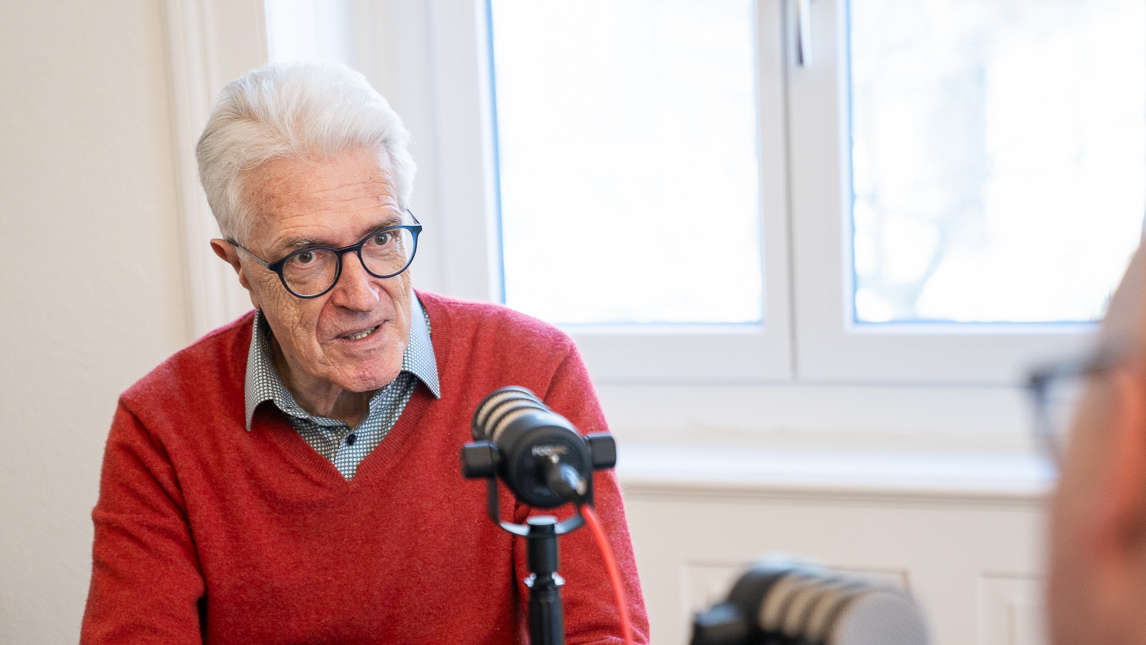
UZH Alumni: You studied sociology, social psychology and ethnology at the University of Zurich (UZH). Was there a course or person who particularly influenced your later path?
Werner van Gent: The “Friday Seminar” led by Professor Peter Heintz, then head of the Institute of Sociology, was one such course. He placed enormous value on sociologically sound and evidence-based analyses of current events — free from any ideology. That was unique in the years following 1968.
Was there a moment when your path into journalism began to take shape?
Werner van Gent: Around halfway through my studies, while leading an introductory seminar, I realized that academic language often obscures more than it clarifies. I wanted to understand the world and share that understanding. At the time, I became convinced that journalism was a better path for that than an academic career.
To what extent have your studies changed your perspective on politics and the media?
Werner van Gent: In scientific thinking, theories are tools for analyzing data. You don’t look for data to prove a preconceived theory. Ideally, the search for scientifically grounded truths should also be journalism’s highest priority — but that’s often not the case. You can see this, for example, in statistical analysis, which should really be used to identify patterns. Unfortunately, statistics are often misused to confirm politically convenient narratives. Social psychologist Professor Gerhard Schmidtchen warned against treating statistics as standalone truth. He summed it up ironically: “With enough imagination, statistics can prove anything.” That has stayed with me.
You met your wife at UZH. Looking back, what role did that time play in your life?
Werner van Gent: Although neither of us studied philosophy — I lacked the required Latin qualification — we often attended philosophy lectures, for example those by Professor Hermann Lübbe. Our ETH friends, with whom we shared an apartment, refused to accept that philosophy was the queen of disciplines. For them, physics held that title. Today, out of pure interest, I study quantum theory and cosmology and have to admit that these two fields can hardly function without one another anymore.
Mobile think tank “Die Runde”
As correspondents for Swiss television, Werner van Gent and Erich Gysling spent decades analyzing global affairs. With their own mobile think tank, “Die Runde” (“The Circle”), they realized a long-held ambition in 2010: bringing experts and engaged audiences together to discuss pressing world events as equals.
Their guiding principle remains: “Keep thinking where ideologies stop helping.” The floor is always open, and the goal is to encourage dialogue and opinion formation. Since the first edition at the legendary Al Bustan Palace in Muscat, the multi-day discussion forum has been hosted in locations including Doha, Kyiv, Tbilisi, Nicosia, Athens, Thessaloniki, Dublin, Vienna, Istanbul, Montreux and, most recently, Riga.
Everyone is welcome to join. The only prerequisite is a strong interest in understanding world affairs.
UZH alumni receive a 10% discount.
You spent many years working as a Middle East correspondent. What originally sparked your interest in the region?
Werner van Gent: Perhaps it was the unfamiliarity of the Orient, the millennia-old cultures of places like Iran and Iraq, the beauty of the landscapes, and of course the sheer intensity of the conflicts. Trying to understand them in all their complexity is an enormous challenge – and at times overwhelming.
Which events during that time left the strongest impression on you?
Werner van Gent: As a young journalist, I reported from various fronts of the Iran–Iraq War, including Saddam Hussein’s chemical attacks against Kurdish civilians in places such as Halabja and Sanandaj. What I saw in the hospitals was deeply disturbing. Later, I witnessed the mass graves during the Kosovo War. Another defining moment came in 2003, when my wife – then working as an NZZ correspondent – and I, together with my TV crew, were caught in an ambush in Iraq. After that, I no longer wanted to work as a war correspondent.
Today you host discussion formats such as “Die Runde” . What attracts you to this role compared with traditional reporting?
Werner van Gent: I co-founded «Die Runde» with Erich Gysling to create exactly what I had missed as a correspondent: direct exchange with the audience. At “Die Runde” , 25 to 30 participants sit at a round table and engage directly with experts — much like the Friday Seminar at the university.
What makes for a good political discussion?
Werner van Gent: Scientific thinking, which involves saying, “I assume this is the case – but it could also be completely different.” That line comes from Professor Reinhard Schulze, who fortunately always takes part in “Die Runde” .
What advice would you give today’s students?
Werner van Gent: Think critically. Question theories. It will take you further. Guaranteed!