Twin Honor for Father of Genetic Scissors
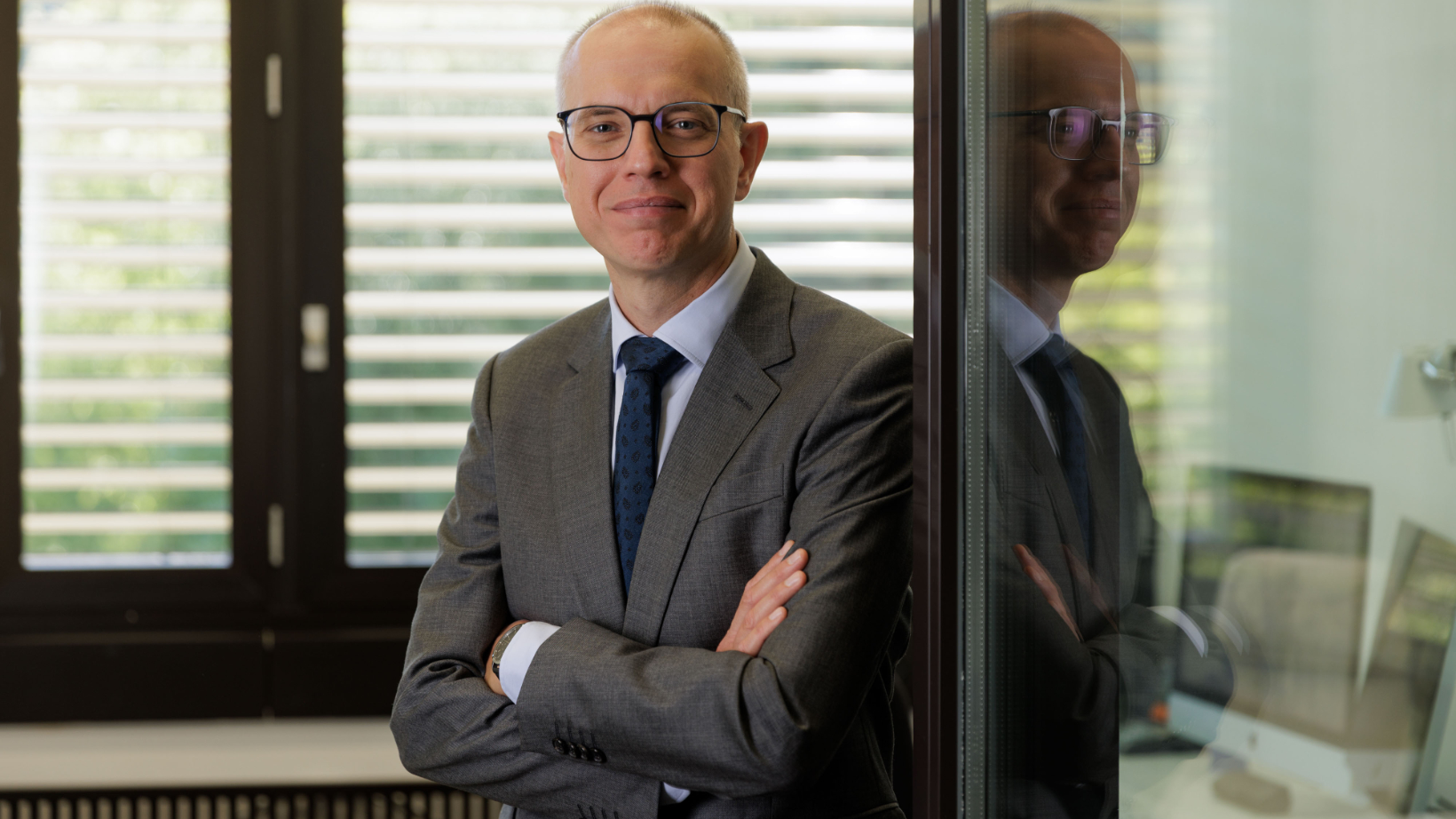
Two prestigious foundations have evidently reached the same conclusion. When they set about looking for potential prizewinners, their experts identified the same researcher, namely Martin Jinek, professor of biochemistry at UZH. In recent months, the 47-year-old scientist therefore received two separate calls informing him that his groundbreaking work in relation to the CRISPR-Cas9 genetic scissors and genome editing was going to be recognized with these prizes. He will now be able to travel to Basel at the end of October to pick up the Max Cloëtta Prize, which is endowed with CHF 50,000, and shortly after this he will collect the Marcel Benoist Prize worth CHF 250,000 in Bern. “It’s an extraordinary honor for me and the team, I’m really delighted to have our basic research recognized in this way,” says Jinek.
This bestowing of prizes comes as no great surprise as it reaffirms the continued research successes of Jinek, who grew up in the Czech Republic and studied natural sciences at the prestigious University of Cambridge. His subsequent work on genetic scissors is based on studying the molecular defense mechanisms that bacteria display against viruses and is a fine example of how basic research can deliver unexpected applications.
He laid the foundation for his success as a postdoctoral researcher with the publication of an article in the Science journal at Jennifer Doudna’s laboratory at the University of California in Berkeley in 2012. Back then, together with laboratory director Doudna and Emmanuelle Charpentier, he discovered that the bacterial defense system CRISPR uses a DNA-cutting protein Cas9 that can be programmed to specific genetic sequences in a targeted way. The technology, known as CRISPR-Cas9 or genetic scissors, thus made it possible to cut and modify desired locations in cells easily and with relative precision.
Narrowly missed out on a Nobel Prize
“We realized even back then that we had found something big, but we couldn’t have imagined how important it would become,” says Martin Jinek. Within a very short time, the genetic scissors became established as a tool in research labs all over the world, opening the door to new applications in medicine and heralding the development of cell and gene therapies. With this work, he narrowly missed out on winning a Nobel Prize, which was awarded in 2020 to Jennifer Doudna and Emmanuelle Charpentier for the genetic scissors. “It’s a long time since a Czech has come so close to winning a Nobel Prize,” reported the press in his home country with regret at the time.
The important publication in Science accelerated the career of Martin Jinek, who was appointed assistant professor in the Department of Biochemistry at UZH in 2013 at the age of 34 and was then promoted to full professor in 2024. He now leads a team of 14 and researches the molecular details of the genetic scissors and related systems used in genome editing. The tools, which have a wide range of uses, have led to the first clinical applications in medicine. For example, there are already approved therapies for treating the blood disease beta-thalassemia and for treating sickle cell anemia based on CRISPR-Cas9. Around a year ago, the treatment of a baby in the USA with a rare genetic disease using an individualized therapy with genetic scissors made the headlines. “There are bound to be more applications,” predicts Jinek.
But as far as their use in medicine is concerned, there are now increasingly also questions about safety because genetic scissors are not always as precise and safe as they were once thought to be. It has now become clear that systems like CRISPR-Cas9 may have undesirable side effects that need to be clarified before any treatment takes place. “One of the aims of our work is to understand the molecular functions of the genetic scissors down to the atomic details and to make them safe for use in potential applications,” says the biochemist.
Next-generation genome editing
To keep developing genome editing, it’s vital to conduct research into new microbial systems, and this is also an area of research in Jinek’s laboratory. This work has since produced other tools that extend beyond the classic CRISPR-Cas9 genetic scissors. One key term used here is bridge recombinase, an enzyme produced from bacteria that Jinek and his colleagues work with. In March 2026, his research group published an article in Science presenting a system based on this enzyme that can replace or insert larger sections of genetic material in the genome of target cells without cutting the double strand of DNA, as previous genetic scissors do. The lead author of this prestigious publication is postdoctoral researcher Oana Pelea. “It’s a key publication that opens up new possibilities – we’ll see where it leads,” says Martin Jinek. Will this be a repeat of the coup of 2012? The researcher is cautious and points out that this is an important collaboration with colleagues from different departments at UZH and ETH Zurich.
Jinek’s reference to this collaboration makes it clear that he was right to move to the University of Zurich after Berkeley in California. “I made the right decision in 2013, the research environment in Zurich is tremendous,” says the prize-winning scientist. The stimulating environment and the opportunities for collaboration could not be better.