“The obvious first response would be to expand public transport”
Why does a university even need its own mobility and transport strategy?
Thomas Marty: In terms of mobility, UZH is like a medium-sized town. We have 40,000 students and staff and 250 buildings spread across Zurich and the surrounding area. While there were plans and official guidelines for individual campuses, there was no overarching framework. Who is actually responsible? How are the campuses connected? That is exactly where the new strategy comes in.
What do we know about how students and staff currently get around?
Marty: Our university-wide survey of students and staff shows that 76 percent travel to UZH by public transport, 13 percent by bike and 5 percent on foot. At 6 percent, car travel accounts for only a small share overall.
When it comes to cycling, we see two trends in the university district in the city center. On the one hand, cycling has been steadily increasing for years. On the other, there is still considerable untapped potential: ETH students cycle in the city center nearly three times as often as UZH students. So the difference can’t be explained by local conditions – the routes, terrain and weather are the same for everyone.
Esra Suel: This is an unusual and interesting case because most mobility research focuses on shifting people away from cars. At UZH, most students and staff already travel by sustainable modes. The challenge therefore lies elsewhere. Demand for public transport is so concentrated that existing infrastructure is under pressure, despite Zurich’s very strong network.

At UZH, most students and staff already travel by sustainable modes. The challenge therefore lies elsewhere.
If the traditional approach – encouraging people to switch from cars to public transport – has little effect here, what other options are there to ease the pressure on public transport – and what are their limitations?
Suel: Cycling could relieve some of the pressure, but parts of the network lack safe and attractive cycling infrastructure. Walking is possible for some trips, but terrain, route quality and time pressure can make it unattractive. Shifting travel times is also difficult because lecture schedules create fixed peaks, and many UZH members commute over longer distances.
What does this imply for the strategy, and where can UZH take concrete action?
Marty: Student numbers have been growing for decades, and forecasts show no sign of that trend reversing. The obvious first response would be to expand public transport. But public transport already accounts for three-quarters of our travel and, as mentioned, is reaching capacity during peak hours. Expanding infrastructure takes years or even decades. This means it’s all the more important to make better use of the potential of cycling and walking and, where possible, to flatten the peaks.
We can control what falls within our own remit: parking facilities, routes on campus, our own services and information. Access to public transport, street space and the city’s cycling infrastructure are decided by others. We need to be involved early on and advocate for UZH’s interests before plans are finalized.
Discounts on Bike-Sharing Schemes
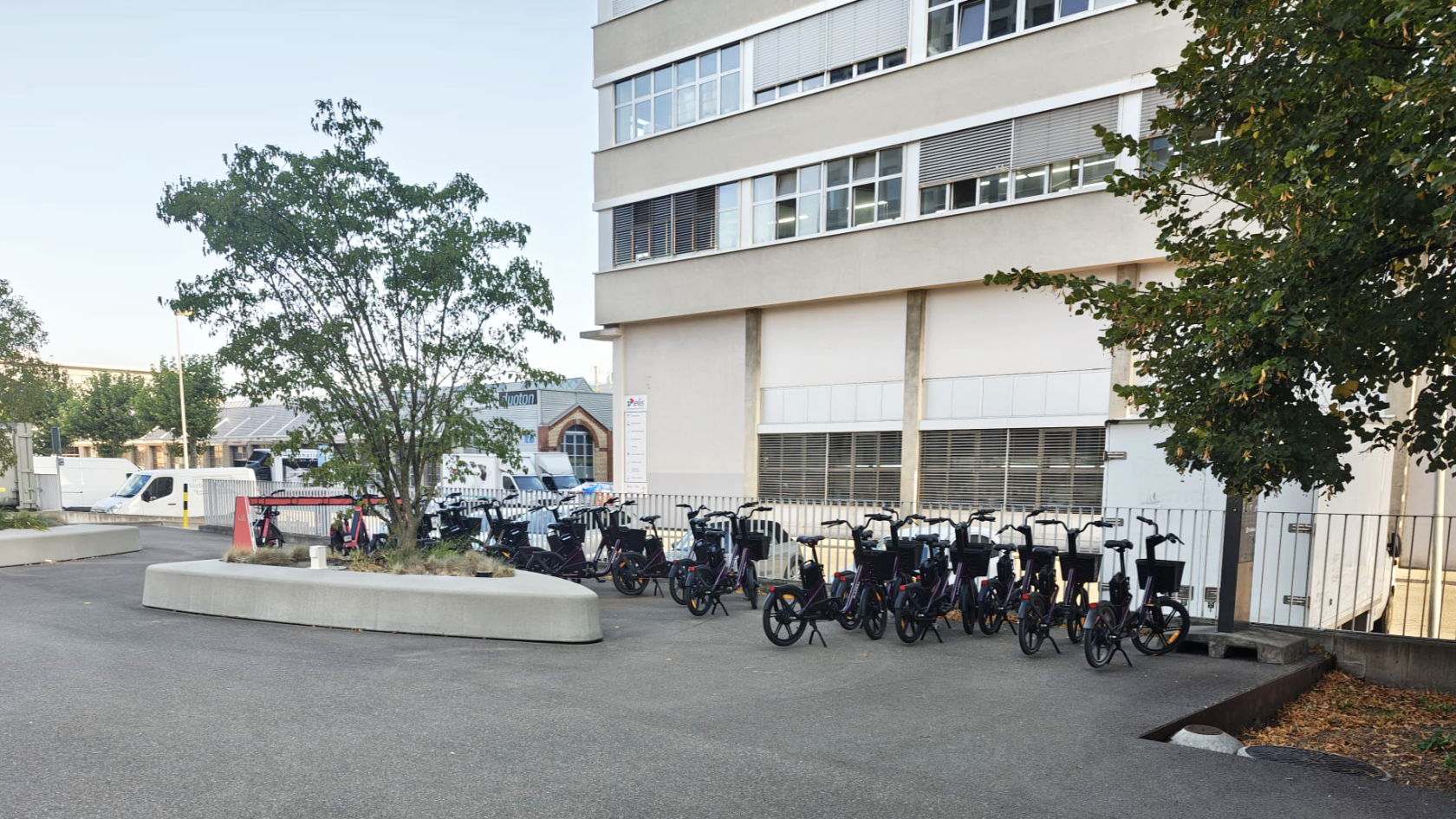
All UZH staff benefit from discounts on bike-sharing schemes – perfect for getting to UZH, traveling between sites, or quick trips into town.
Voi – E-Bike and E-Scooter-Sharing
As a member of staff at UZH, you benefit from exclusive special rates on the entire Voi scheme in Zurich – with 800 e-bikes and 800 e-scooters throughout the city.
PubliBike – Cycle and E-Bike Sharing
With a BusinessBike subscription the first 60 minutes on a bicycle or the first 15 minutes on an e-bike are free – perfect for the typical commuting distance from the station or from home.
SwitchBike – Bicycle Subscription
SwitchBike offers a flexible bicycle subscription without the obligations that come with ownership.
Research also plays a role in the strategy. A core idea is to use the university itself as a living lab for mobility research. Could you elaborate what this means?
Suel: A living lab means using the university as a real-world setting for research and teaching. UZH’s mobility challenges are particularly interesting because students experience them in their daily lives while also being able to collect data within the university community. This allows students to apply research methods to a problem that is relevant to their own campus and generate insights that may also benefit the university. Students are often much more motivated when they see that their work can help improve the environment in which they study and work. One topic we want to examine more closely is “walkability.”
What actually makes a route “walkable” – and why is this of interest to UZH?
Suel: Think of routes that make you want to walk and compare them with those you’d rather avoid. Walkability isn’t just about distance, but also about whether destinations are easy to reach, and how safe and appealing a route feels – for example, whether it has pleasant pavements and crossings, green spaces, cafés or other people around.
For UZH, this is particularly relevant for short trips, such as between the main train station and City Campus, or in the areas surrounding the various campuses – especially where public transport is under pressure. Understanding how suitable these routes are for walking can show us where conditions could be improved.
A Master’s thesis on this topic will begin this summer. What do you hope to gain from it?
Suel: The surveys conducted so far show how students and staff currently get around. The data help us understand how mobility can be made more sustainable, especially in areas where sustainable modes of transportation are reaching their limits. The Master’s thesis goes a step further by asking why people travel the way they do and what might motivate them to change their behavior. There will be a particular focus on perceived walkability. We’ll be conducting an additional survey on this topic at the start of the semester, so look out for it!
In ten years, I’d like good mobility at UZH to be a given. You get off the train at Oerlikon, grab a shared bike and, when you arrive at the Irchel Campus, there’s a dry, secure parking spot waiting for you right by the entrance.
What options are already available, and what will be added in the coming years?
Marty: UZH staff and students can already take advantage of discounted bike-sharing and reduced rates on bike subscriptions. There’s also a mobility-sharing hub at the Schlieren Campus. And a free shuttle runs directly between the City Campus and Oerlikon Campus.
The biggest challenge for the coming years will be our cycling infrastructure. Many bicycle parking facilities currently fall short in terms of quality. Preparatory work is underway to make substantial improvements at all of our campuses.
What will mobility at UZH ideally look like in five to ten years?
Marty: In ten years, I’d like good mobility at UZH to be a given. You get off the train at Oerlikon, grab a shared bike and, when you arrive at the Irchel Campus, there’s a dry, secure parking spot waiting for you right by the entrance. Traveling between campuses is no longer a hurdle, but part of a connected campus that spans the entire city.
Suel: Ideally, UZH would become a long-term living lab that extends beyond individual student projects. New mobility measures could be evaluated as they are introduced, allowing us to study their impact. This would help us test fundamental theories of mobility behavior and generate evidence that could benefit not only UZH but also other universities and cities.