A Global Spotlight on LGBTIQ+ Health
When Tabea Hässler talks about research, one word stands out: bridges. Bridges between countries and continents, between academia and practice, and between LGBTIQ+ organizations, policymakers and institutions.
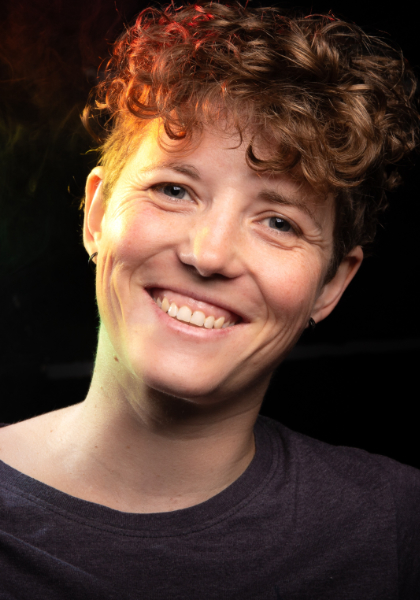
At the University of Zurich (UZH), Tabea Hässler has spent many years researching how discrimination, social support and societal conditions shape the lives of LGBTIQ+ people: lesbian, gay, bisexual, trans, intersex and queer individuals. Their work examines not only the challenges LGBTIQ+ people face, but also what helps them thrive: a sense of belonging, visibility, legal recognition and support in everyday life. “I went into social psychology because I wanted to make a difference in society,” says Tabea Hässler. “If research does not have an impact, a central part of why I do science is missing.”
If we focus only on negative experiences, we create a very one-sided narrative. We also want to understand what strengthens LGBTIQ+ people.
Building bridges has been central to Hässler’s work since their doctoral studies. Even then, Hässler initiated an international project involving researchers from 23 countries. The focus of this social-psychological research on intergroup contact was how encounters between different social groups can help reduce prejudice. Now, that work is entering a new phase. With the Global LGBTIQ+ Health Project, funded by an SNSF Starting Grant, Hässler is building a network that brings together 130 researchers and representatives from LGBTIQ+ organizations across more than 70 countries.
The project’s kick-off workshop will take place at UZH from 23 to 26 June. Several events are open to the public and are aimed specifically at students, early-career researchers and UZH employees (see box).
Global LGBTIQ+ perspectives in Zurich
The kick-off workshop in Zurich will be the first major in-person gathering of the new network. Around 80 participants from every continent are expected, including experts in public health, social psychology and clinical research, as well as representatives of community groups, international organizations and LGBTIQ+ organizations.
In addition to launching the research project, the workshop will focus on long-term collaboration: mentoring, exchange across career stages and the formation of cross-continental project groups that will work on reports and academic publications in the future. The project will also be documented through a film and a podcast. At a time when LGBTIQ+ rights are coming under increasing pressure in many countries, this gathering at UZH during Pride Month is especially significant.
“The world is coming to Zurich,” says Hässler. “For students, early-career researchers and employees, this is a unique opportunity to engage with people from every continent.”
One such opportunity will be the public panel discussion Standing United Against Global Backlash on Tuesday, 23 June, at 6:30 p.m. at the Zurich Central Library. Project partners from Africa, Asia, Europe, North America, Latin America and Oceania will explore why international collaboration is essential in the current political climate. Tabea Hässler will moderate the discussion.
On Wednesday, 24 June, beginning at 9 a.m. in the main lecture hall, researchers and practitioners will discuss the realities facing LGBTIQ+ people around the world. The program will conclude on Friday, 26 June, at 4:00 p.m. with an outlook on the next steps of the Global LGBTIQ+ Health Project, followed by an apéro.
Health, safety and belonging
The global project examines factors that are relevant to the health of LGBTIQ+ people, including discrimination, safety, legal recognition, social support and belonging. Exclusion often begins in everyday situations, with derogatory jokes, being addressed incorrectly or forms that fail to reflect people’s identities. Structural disadvantages, bullying, sexual harassment and physical violence further compound these challenges.
As a result, many LGBTIQ+ people constantly assess their surroundings: Where am I safe? Who can I tell about my partner? When do I feel safe enough to share my name or pronouns? When is it safer to say nothing? In research, this phenomenon is known as minority stress: the additional, chronic stress associated with belonging to a stigmatized group. Studies show that this type of stress can have both psychological and physical consequences.
Equally important is understanding the conditions under which LGBTIQ+ people thrive. “If we focus only on negative experiences, we create a very one-sided narrative,” says Hässler. “We also want to understand what strengthens LGBTIQ+ people.” Specifically, the project investigates which forms of support are effective in families, partnerships, schools, universities, healthcare institutions, workplaces and communities.
Hässler sees concrete examples at UZH that make this kind of support visible in everyday life. Important signals include the rainbow flags outside the Main Building, gender-neutral toilets, inclusive forms and use of pronouns, and inclusive examples in teaching and research that naturally take diverse life experiences into account. “These measures may seem small at first glance,” says Hässler, “but for many LGBTIQ+ people and individuals belonging to other social minorities they send an important message: ‘I am welcome. Here, I can be myself.’”
Research as a partnership of equals
With a project of this scale, questions of coordination naturally arise. After all, building a network across more than 70 countries is a major organizational undertaking. According to Tabea Hässler, the network developed organically through connections established in previous research projects, research stays abroad, conferences and years of building trust. One such opportunity came last fall at the UQ–UZH Symposium in Australia provided an opportunity to strengthen research collaborations and raise awareness of the Global LGBTIQ+ Health Project across the Asia-Pacific region.
Concepts, lived realities and risks vary considerably from one country to another. In some countries, LGBTIQ+ people can marry and live openly with legal recognition; in others, same-sex relationships are criminalized or actively persecuted. Even coming out, a concept that is often viewed positively in Western research, cannot be understood in the same way everywhere. For this reason, Hässler wants to avoid a model in which a team in Western Europe or North America defines the research questions while partners elsewhere are involved only in collecting data.
“Global research only works when local expertise is integrated from the very beginning,” says Hässler. “People on the ground understand the social conditions, communities and safety concerns far better.” As a result, participants in the Global LGBTIQ+ Health Project are developing the survey together, discussing cultural differences and assessing which questions can be compared globally and where region-specific modules are more appropriate. In addition to researchers, representatives of LGBTIQ+ organizations and practitioners are actively involved.
The potential impact of this type of collaboration is already evident in the Swiss LGBTIQ+ Panel. Since 2019, Tabea Hässler and Léïla Eisner have led this independent longitudinal study examining the situation of LGBTIQ+ people in Switzerland. Its findings are presented in an accessible format. “We see that our reports are being used by policymakers, cantonal authorities, cities and organizations,” says Hässler. “This kind of knowledge transfer is exactly what is needed to bridge knowledge divides and ensure that research has a real-world impact.”