From Cleanroom to Market
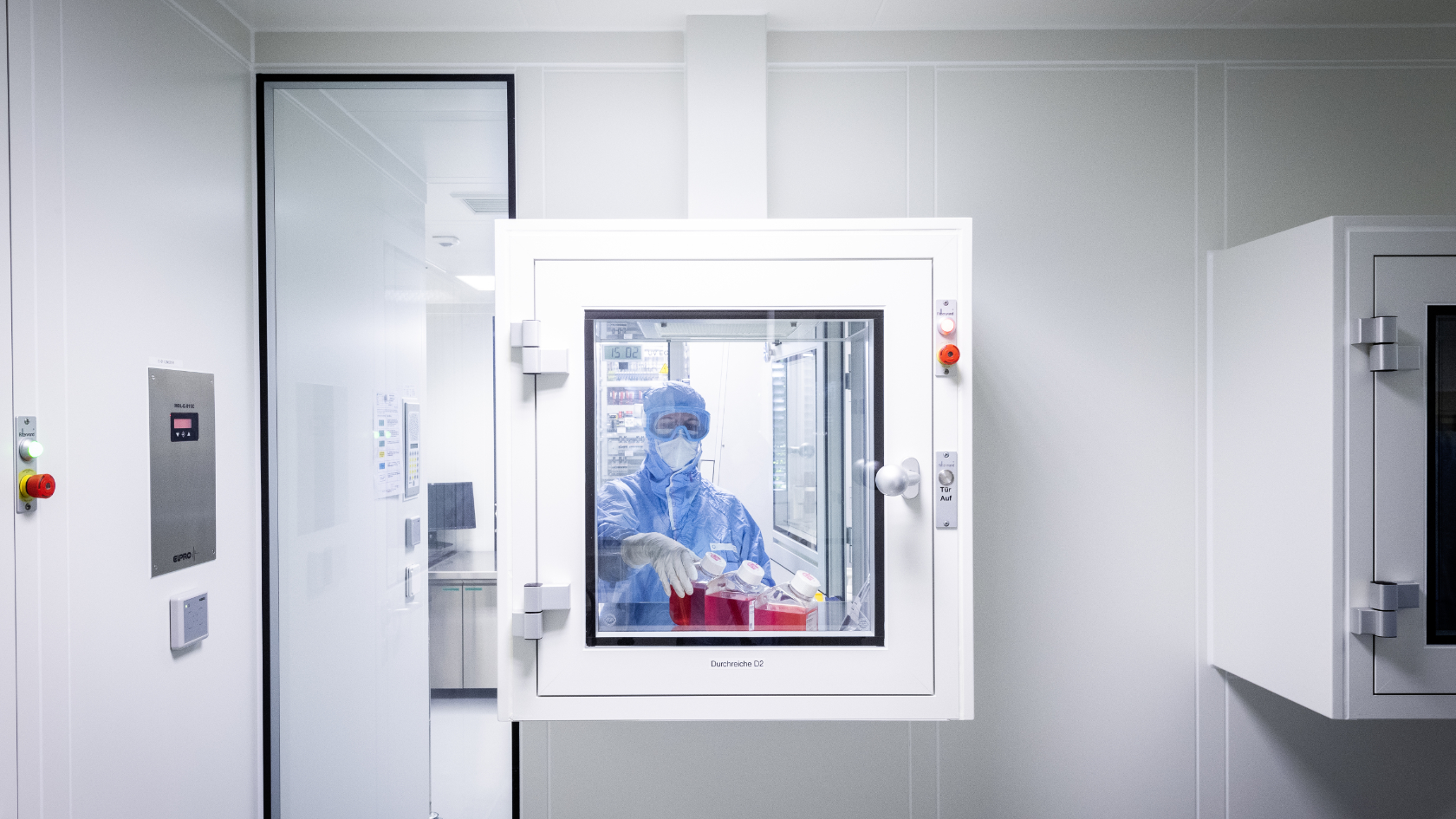
You’d be hard pressed to find cleaner rooms than these. Five boxes, each with a laminar flow cabinet, incubators, pumps and a microscope. Ten square meters, no more. Sterile air flows in continuously. All the air in the room is exchanged for sterile air around 50 times an hour, or almost once every minute. If you want to access this area, you need to pass through several airlocks, wearing a full-body suit, including gloves, goggles and face protection. All material is disinfected and introduced separately.
This procedure is necessary to keep out the many germs and microorganisms that populate our body and our environment. Particles and germs can contaminate samples, distort trial results and present a threat to patients – this is the worst thing that can happen in the kind of cell and gene therapy research that is conducted here. To prevent this from happening, 100 sensors are installed to monitor the atmosphere throughout the facility. They continuously measure parameters such as air pressure, humidity, particles or the CO2 level in the incubators.
There are a total of five of these sterile work boxes located in the Regenerative Medicine Technology Platform (RMTP) building, a short walk from UZH’s City Campus. It’s not just researchers, but also cleaners or technicians that need to enter the facility, who must be trained and qualified to do so. “The hygiene requirements here are stricter than they are in an operating room in a hospital,” says Martin Kayser. He is CTO at Wyss Zurich and responsible for the facility and for quality management.
The regulations don’t just cover hygiene. Each step must also be documented, and this needs to be done well in advance. Any deviations must be recorded and an explanation of the cause provided if possible. The procedure is regulated by Swissmedic, the regulatory authority in Switzerland. “The trial-and-error principle that is commonly employed in research doesn’t work here,” says Kayser. “There’s only a few industries that have such strict quality management.” It goes without saying that this is all very time-consuming and expensive.
Unique in Switzerland
The certified cleanrooms are a unique facility in the academic sphere. There are no other comparable facilities in Switzerland and only very few elsewhere in the world. In general, it’s only pharmaceutical or biotechnology companies that have this kind of infrastructure. It’s only available at Zurich’s universities because Wyss Zurich pays the operating and maintenance costs. The joint institution of UZH and ETH Zurich is committed to translating basic research into therapeutic benefits for patients (see box). The high-tech labs are a key piece in the jigsaw.
Wyss Zurich – Turning innovative research into products
This is because in this industry the journey from the initial scientific idea to getting an actual product to market is long. If investors are going to take the risk and inject a lot of money into a biotechnology or medical technology start-up, they first want to see some initial reliable data from preclinical and early-phase clinical trials. And the certified cleanroom labs located on Moussonstrasse in Zurich are there to provide this data.
Transcending the “Valley of Death”
It’s in this early phase of product development that Wyss Zurich steps in. It is also known as the “Valley of Death” – a reference to the fact that many promising scientific ideas die a death during this phase. This is because, in the years after a company is founded, the therapy needs to keep evolving while at the same time the start-ups have to deal with a huge number of regulatory requirements and demands from the world of finance.
Many researchers find the demands impossible to manage. Firstly, because they’re simply unfamiliar with all the regulations and business plans. And secondly, because they don’t have the capital they need to hire staff who are trained in this area.
This is where the Wyss Zurich Foundation steps in – the foundation set up by Hansjörg Wyss 10 years ago specifically promotes projects, gives them financial support and coaches the founders – until they ideally reach a point where their business attracts interest from private investors.
“Traditional venture capitalists work within a timeframe of three to five years. They’ll invest if there’s a prospect of clinical trials being carried out in one to two years,” says Andrin Oswald, CEO of Somagenetix. The UZH spin-off has received support from Wyss Zurich since 2019 and has used one of the cleanrooms located on Moussonstrasse to continue developing a gene therapy for chronic granulomatosis. This is a rare congenital immune disease.
In the fall of 2024, the start-up managed to get through the “Valley of Death” when it received CHF 10 million from private investors. The planned clinical trial is currently being reviewed by Swissmedic. The therapy is set to be tested on the first patients from fall 2026.
Specific know-how and capital
Oswald explains that Somagenetix was no different to any other university spin-offs during the early phase. “To comply with the guidelines of good manufacturing practice or create a business plan, you need specific know-how and capital running into the millions. This is beyond the scope of what the scientific world can provide,” says Oswald. In the case of Somagenetix, it took almost five years from when the company was founded to get to the point when trials were carried out on animal models and a business plan was created – making the start-up attractive to investors.
Without the support that Somagenetix received from Wyss Zurich, Oswald himself would probably never have joined the company, as he explains. He had spent many years working in management positions in the pharmaceutical industry, including at Novartis and GlaxoSmithKline, when the Somagenetix founders led by UZH professor Janine Reichenbach approached him in 2022.
Oswald had the skills and knowledge from the world of finance and industry that the academic founders lacked. “As well as the discussions I had with the founding team, the Wyss label was a crucial reason why I decided to say yes,” recalls Oswald.
Artificial heart valves, new skin
After a decade of funding, the investments made by the foundation are now starting to bear fruit. In addition to Somagenetix, there are plenty of other success stories: for example, there’s the company Cutiss whose denovoSkin product, a bioengineered skin tissue, is usedfor treating severe burns that children and adults have suffered, and also in reconstructive skin surgery. The tissue is made from the patients’ own cells. Up until 2022, the company was supported by Wyss Zurich with access to cleanroom labs in particular. It has now experienced several successful rounds of financing and set up its own cleanroom in Schlieren. Cutiss is currently working withTecan to automate and industrialize its manufacturing processes.
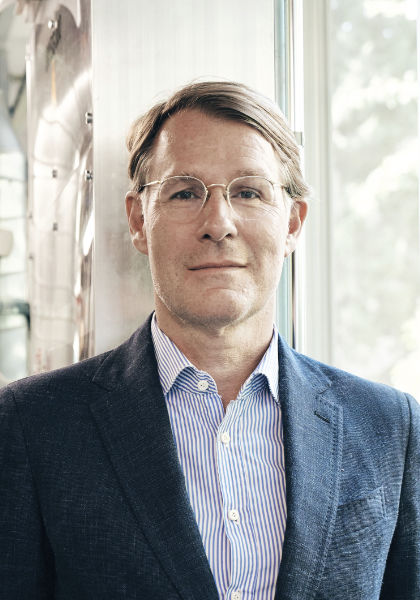
Our biomimetic research shows how complex innovations work. It’s a case of taking two steps forward and then often also one step back.
Another company set to enter the clinical phase very soon is LifeMatrix. The start-up produces heart valves, blood vessels and other implants for people with cardiovascular diseases that will grow inside the patient’s body – this provides a huge benefit for children born with a congenital heart defect, for example. The tissue is produced in the laboratory and is based on human donor cells.
One of the founders of LifeMatrix is Simon Hoerstrup, professor at the Institute of Regenerative Medicine at the University of Zurich and founder and co-director of Wyss Zurich. “Our biomimetic research can be used to show how complex innovations work in prototype form,” says Hoerstrup, “it’s a case of taking two steps forward and then often also one step back.”
At first, they succeeded relatively quickly in producing heart valves and blood vessels in the laboratory that will grow with a child and could have been given to a child as an implant. “But we were faced with major logistical problems because the operations need to be scheduled for a specific day. This is because the living implants produced in the laboratory could not be stored for a lengthy period of time, similar to a human organ earmarked for transplant.”
But what if the child has a fever or suffers some other complication on the scheduled day of the operation? “We would have had to produce a number of implants in each case, essentially as a backup for the corresponding postponed dates. So it was clear that our technology at the time would not have been suitable for widespread application because of the complex logistics and high costs involved.”
Maintain ties with academia
Now, six years later, the team has worked with the experts from the Regenerative Medicine Technology Platform to advance the technology, which now allows them to produce implants that can easily be stored in a hospital for six months or longer. This kind of back and forth is completely normal when you’re working with complex innovations. “But a venture capitalist is unlikely to have been willing to fund these additional years,” says Hoerstrup. This is why Wyss Zurich was needed.
Start-ups that receive support from private investors at an early stage often end up focusing too much on one product and cut their ties with academia unnecessarily prematurely, says Hoerstrup. This often makes it impossible to implement new findings and advances in development at an early stage and improve the technology. “In this situation, economic interests and development are linked together too early, especially in the case of complex biotechnologies.” The support that Wyss Zurich provides to start-ups enables them to get through this difficult phase without losing sight of the crucial need to keep developing the concept.

Hoerstrup is hoping for another donation from Hansjörg Wyss to allow start-ups to continue benefiting from this funding in the future. But at the same time, the foundation is also pursuing other ways to secure financial backing for Wyss Zurich over the long term.
The concept of Wyss Zurich is also of potential interest to other patrons. The foundation could also receive part of its funding from considerable returns from companies that have successfully made the step into industry. After all, the patents for the start-ups’ technologies are still owned by the universities. What’s more, the universities own stakes in the companies in the form of shares and can receive their share of the profits through license fees. “These returns go to the university and to Wyss Zurich and are therefore available to be used to fund innovations that emerge from our university research,” says Hoerstrup.
However, the notion that this income will be on a par with the donations from Hansjörg Wyss is currently unrealistic. “That would only be possible if the projects funded by Wyss were to produce a blockbuster company that develops a drug to treat Alzheimer’s, for example,” says Hoerstrup. So the goal is more to ensure that any financial returns provide part of the funding for the foundation.