Basic research is coming under increasing pressure. Yet without it, there can be no academic progress, say UZH Vice President Elisabeth Stark and statistician Servan Grüninger.
Sulfur-crested cockatoos are clever, curious and they constantly learn from one another. Evolutionary biologist Lucy Aplin is studying how they do this.
What makes us human? Researchers have been grappling with this question for centuries. In the latest issue of the UZH Magazin, researchers from different fields across the university offer their answers.
Roman Horbyk researches the impact of mobile phones and digital propaganda on modern warfare – a topic that blends the media specialist’s academic work with personal experience.
What does Christian love mean? And can it still serve as a moral compass today? These are the questions an international research project led by ethicist Michael Coors set out to answer.
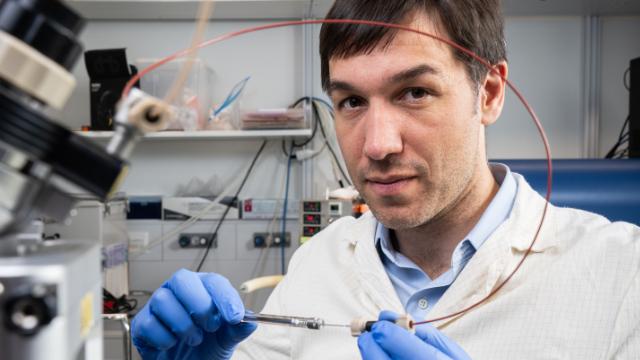
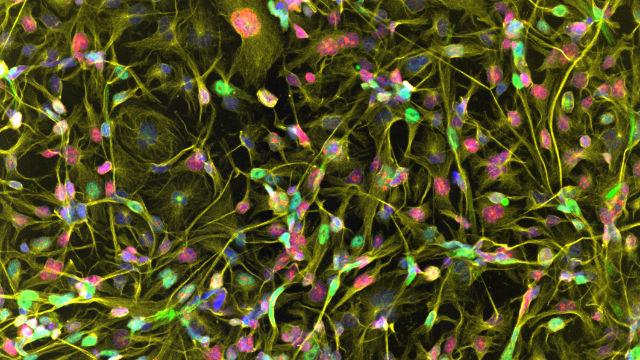
Brain tumors are the most fatal form of cancer in children and adolescents. Ana Guerreiro Stücklin is investigating new therapies against gene fusions that cause cancer.
Psychologist Anna Graf support children and adolescents who are undergoing cancer treatment at the University Children’s Hospital. Her tools include toys, books and colorful glass beads.
Pediatric oncologist Jean-Pierre Bourquin is working to develop gentler therapies and seeking ways of tackling aggressive forms of blood cancer more effectively.
Kilian Käslin developed leukemia as a baby. The diagnosis marked the start of a months-long battle for his life that required his family and doctors to give their all.
Today, many children with cancer can be treated successfully. A new Center of Competence in Research aims to make treatments even more targeted and effective. Read more in the UZH Magazin.
A meritocratic system only works if everyone gets a fair start. Economists Ernst Fehr and Steven Ongena explain how education, a health and social security system and taxation help.
Social decline – or the fear of it – is pushing people to vote for far-right parties. But trust in government rises when those struggling feel valued and receive support.
Number theory is the branch of mathematics dedicated to the magic of natural numbers. Claire Burrin, assistant professor of mathematics, specializes in this field.
Inscriptions from the Hellenistic and Roman periods are rich sources of information about life in ancient times. Databases make them available for research.
Political decisions often create winners and losers. As research by economist Maya Eden shows, predictable and transparent criteria can help minimize unfairness.
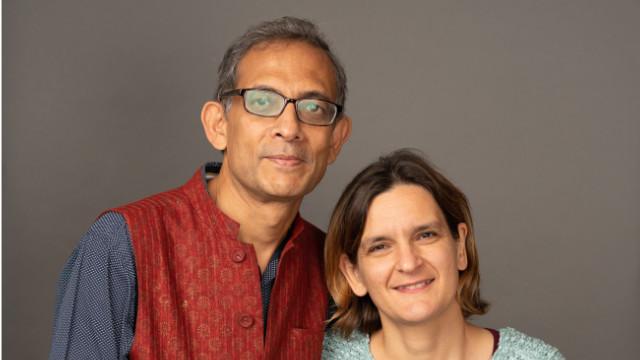
Esther Duflo and Abhijit Banerjee are fighting poverty with rigorous experiments and concrete policies. An interview with the Nobel-winning economists.
There’s no easy way to achieve fair taxation. It takes a bundle of pragmatic measures to close loopholes, minimize false incentives, and tax work and capital evenly.
Russia, China and the U.S. are flouting the principles of the rules-based international order. Historian Jeronim Perović and international law expert Oliver Diggelmann weigh in.
How can poverty be tackled more effectively? How can companies be held accountable? The new issue of the UZH Magazin explores how researchers at UZH are addressing these questions.
At the UZH Healthy Longevity Center, researchers working across disciplines are developing solutions that help older people live healthier, happier lives.
Our eating habits are often unhealthy and take a long time to change. Psychologist Sebastian Bürgler and nutrition scientist Sabine Rohrmann explore why that is and what we can do about it.
The modern world offers an abundance of convenience foods. But our Stone Age physiology isn’t built for modern diets, which are taking their toll on our bodies.







-und-Perovic-mit-dem-St.Galler-Globus-im-Landesmuseum-in-Zürich-Kopie.jpg/jcr:content.jpg)